 |
https://cosmosmagazine.com/archaeology/neanderthals-live-us/ - The relationship between H. neanderthalensis and H. sapiens is much closer than a lot of people think.
|
Dwarves live underground. Yeah that's cool, but why?
Dwarves are shorter and more beardy than humans. Yeah sure, but why?
Dwarven craftspeople are renowned for their meticulous work. Yeah, but why?!
Dwarves are resistant to poison. Yeah cool but please tell me WHYYYY!!
The people of the dark, our mysterious and taciturn cousins, the Khuzd, as Tolkien termed them. Dwarves, as deemed by the common tongue, come from a world unlike our own. A world of cold and darkness, of shifting shadows and inhospitable crags. In this post I'm going to talk about various anthropological ideas and how we could use them to think about the different races of D&D- in this case, Dwarves. The theories and ideas I'll be touching upon come from human evolution and our close relatives the Neanderthals, the Kula from Malinowski's Argonauts of the Western Pacific, The Gift by Marcel Mauss, and the Sapir-Whorf hypothesis of linguistic and cognitive interrelation.
The Biological
I was first interested in expounding on the history of the Dwarves after
reading about how similar they could be to our cousins in the real world- the Neanderthals. With a background in human evolution, it makes perfect sense to me. Neanderthals evolved in the relative cold and dark of ice-age Europe after a migration of an earlier species of
Homo found themselves isolated from African and Asian populations by glaciation and a cooler climate. The Europe of half-a-million years ago was, relative to the vast open plains of Africa and the dense hot jungles of Asia, a gloomy and frigid place. Let's move further into the realm of D&D to have a look at the rules
which apply to the race, and what this might say about their
evolutionary heritage.
Dwarves get a constitution bonus of +2. This implies they are tough and robust. From the fossil evidence, we know that the average Neanderthal's body plan is stout and broad, with shorter limbs than their more gracile cousins- perfectly suited to a cold environment. Creatures which are adapted to the cold are often shorter and stockier, with a greater mass to surface area ratio than their warm climate relatives (see
Bergmann's and
Allen's rules). Not only this, but their
Dwarven Resilience rule suggests that they are adapted to an environment of dietary scarcity or scavenging behaviour akin to vultures. It might also suggest that they had to resort to eating poisonous plants or fungi as a
fallback food. Fallback foods are what a species relies upon when their preferred diet is unavailable, generally thought as a more effective driver of digestive and masticatory (chewing) anatomy than a species's preferred food source- if you can't survive in times of scarcity, you won't make it to when the good food comes back.
The article I referenced above also talks about some of the Neanderthals' other anatomical features, such as a wider nasal cavity (for greater heat retention and warming of the cold air being inhaled through the nose) and larger eye sockets (for better vision in Europe's darker climate). If you haven't read it yet, you should give it a look, it's pretty cool.
Their darkvision ability is a little harder to rationalise, being a somewhat supernatural ability which lets a creature see in total darkness rather than just low-light conditions, but what it suggests to me is that perhaps Dwarves (and other races which can see in the dark- goblins, elves, etc.) possess something like a
Tapetum Lucidum- a layer of reflective tissue at the back of the eye which allows the retinal cells to collect more light and thus see more clearly in darkened conditions. It's responsible for that 'eyeshine' effect so often seen when you shine a torch at a cat in the dark, or take its photo. Although absent in primates (that's why nocturnal species like tarsiers have such massive

eyes instead), given that this anatomical feature is a common mammalian adaptation, there's no reason it couldn't make an appearance in a fantasy setting. Also the idea of Dwarves' eyes catching the light from glowing embers at the edge of the party's campsite is pretty cool. In any case, this adaptation often suggests a nocturnal activity pattern, but for our purposes, it could just as readily suggest a semi-subterranean one.
From the evidence, we might see a pattern emerging which suggests an evolutionary environment of extremely harsh winters- arctic even- combined with the existence of safe havens in the form of massive, sprawling caves and caverns complete with poisonous fungi. Perhaps to cope with the biting cold of winter, this species used underground habitats as shelter. To adapt to the scarcity of this environment, acquisition of poison resistance and a tapetum lucidum allowed them to survive until temperatures above ground increased, even if only marginally. Populations would probably return to the same underground havens year after year, using them as places to live, to raise young, and bury their dead.
We can also see from numerous sources of evidence that Neanderthals weren't the thoughtless primitives that we used to imagine- the mythical 'cave man.' They could engage in complex symbolic thought,
created art, and were probably able to use linguistic expression in the same way as humans. In fact we are so similar that there are a number of anthropologists who even consider them the same species as
H. sapiens, owing to the evidence that neanderthal DNA is found in human populations to this day. Allegedly, this interbreeding between populations is where we get the gene for red hair, straight hair, increased body hair, red cheeks, and even freckles. Much literature on the topic is still emerging and it's an exciting time for paleoanthropologists and geneticists alike.
The ... Social?
I'm inserting this subtitle because it's a moiety I feel comfortable with, but in reality it isn't as simple as that. There's a gradual segue between the biological and social sides of anthropology. Or in this case ... Dwarthropology?
As you might be imagining, we see an interesting evolutionary context forming. This can function as the basis for an emergent Dwarfish culture. Over time, populations return again and again to these previously mentioned underground winter havens, and they begin to venerate them as sacred places. They regard them as an ancestral home, and those who preceded them have been interred there over the generations. Perhaps contemporary populations imagine or believe they are being watched over by their ancestors, or that these havens are to be guarded- defended from interlopers and strangers. Their subterranean home is both a place to seek sanctuary and a place to be staunchly defended.
Sociality and Survival
During the winter months, these settlements are isolated almost entirely from the rest of the world. No trade happens, no communication. And I would imagine also that because of the fantastic nature of this world, perils from below are just as present as perils from above. Goblins and other snarling, creeping creatures of the deep dark provide a lurking terror for the Dwarves who venture further below. We might also imagine the kind of society which would exist in a place
like this. Existing in close proximity for a number of months at a time
might require strict rules and codes of conduct for maintaining social
order. A tight-knit community which values social cohesion and working together would stand a better chance than one stricken with internecine squabbles- this reflects the D&D rulebook's suggestion that Dwarves favour a lawful alignment. The laws of the hearth, house, and home are sacrosanct, handed down from antiquity.
Voyages of Exchange- The Gift and the Argonauts of the frozen north
Two landmark texts of social anthropology, The Gift by Marcel Mauss and Argonauts of the Western Pacific by Bronislaw Malinowski, have an interesting parallel here. Without going into too much detail about the academic side of it, these treatise talk about economies of gift exchange in paticular societies. One of these happens to be a loose collection of tribes in a place known as the Trobriand islands in Papua New Guinea. These isolated communities take to the seas and sail vast distances, risking their lives to partake in the exchange of trinkets and other goods. The system is known as the Kula ring, and pieces of jewellery make their way in a circuit around the islands, exchanging hands, and linking the gift giver and receiver inextricably, some say for life. The interesting thing here is that this mechanism of exchange, this ritualised gifting, serves to tie loose tribes together and create bonds which foster migration and economic activity between the two, whilst also elevating the status of the one who undertakes the journey within their own tribe.
We might say for our purposes that this Kula exchange appears in Dwarven society too. During the brief summer months, when conditions above ground allow it, a frenzy of activity takes place between previously isolated tribes. They come together, hosting those who travel over the forbidding mountain ranges and through the glacial valleys to give lavish gifts. Perhaps there is a long and deep tradition of hospitality amongst these peoples. And that these trinkets, the symbolic tokens which mark someone as an experienced traveller, grow in number the more journeys one undertakes. Older members of a tribe might have dozens of bangles, necklaces, beard rings, or some other kind of hand-crafted jewellery inscribed with the names of those who held it before. Perhaps they could even carry good luck wishes for the ones who carry it in the future.
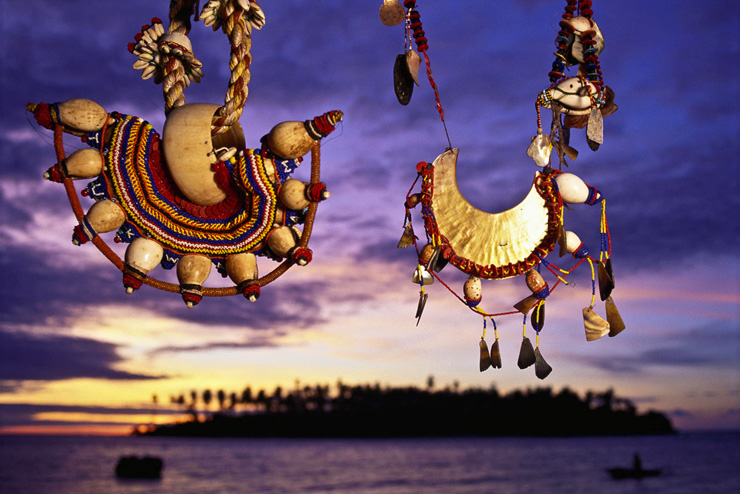 |
Hand-crafted jewellry from the Trobriand islands, similar to that used in the Kula ring written about by Malinowski.
|
How many words do they have for the dark?
When I studied a bit of social Anthropology at undergrad, I spent a couple of terms thinking about culture, cognition, and linguistics. This corner of a much larger course focused primarily on the difficulty of the Sapir-Whorf hypothesis or, more accessibly, the idea that a person's or a people's language changes the way they think about the world.
This is best illustrated by the old story that Inuits have about fifty words for snow or something like that. Everyone's heard that one, and the explanation is fairly reasonable. People are unsure generally whether this is a myth or not, but it seems like there is at least a grain of truth to it. Because Inuit cultures and languages developed in a cold place with lots of snow, they recognised that there were different kinds of snow and as such their language developed ways of describing them accordingly. It isn't so much that they have many different words for the same thing- I'm not simply talking about a kind of linguistic redundancy- more like they have intricate ways of describing subtle variations in a common phenomenon.
A more contemporary version of this might be the many, many different names we have for a nice cup of coffee. Americano, latte, cappuccino, long black, flat white, macchiato, espresso, filter, cortado, etc etc... You get the idea. The variety of language we have for different types of coffee helps us to appreciate the differences between them, and think about the topic in more depth. I'd like to point out my use of the word 'helps' here- we can still think about things without the language to facilitate it, albeit more nebulously. The vocabulary helps us to clarify our thoughts, but lack of language doesn't stop us being able to think something which we can't quite articulate. When I was working in cafes, I would get a little exasperated when
people would come up to the counter and ask for "just a normal coffee." There's nothing ab-normal
about all these different types of drink, the patron simply lacked the
knowledge to discern between them, and regarded them all as a confusing
mess. This isn't a condemnation, it's just a meeting of two different schema, two alternate maps of understanding.
To bring it back to the world of fantay, the thing which Dwarves unoubtedly spend their time immersed in is a dark enviroment. They could have dozens of ways to describe different kinds of darkness. Subtle variations in tone, perhaps even varying degrees of near-darkness and colour of light. Accompanying sounds, temperature, moisture level, percieved danger, emotional state of the perciever, smell- these could all contribute to a deep and rich vocabulary which comes from an a appreciation for all things unlit. Simply saying somewhere is "dark" when a Dwarf is in earshot might prompt bafflement or derision. Something like "What do you mean?" To which an uncultured human might reply, "You know, just normal dark. Like, when you can't see anything." The philistine.
Let's end things with a little imaginative delve into types of dark- a literal translation of the Dwarven word, followed by a slightly more detailed description.
Stone-pressing: This word describes the kind of dark where you know you are surrounded on all siddes by impenetrable walls of solid, metamorphic rock. Stones which have been still since the beginning of time, pressed and crushed into a form so strong and dense that nothing in existence can move them. There is no sound except your own breathing, the beating of your own heart, blood rushing through your ears. There is no movement of air, it is just closeness, stillness. A kind of peace. In the language of the Dwarves it sounds almost like the word for home.
Young-billow: The feeling of cold seeping into the ends of your toes and fingers, the tip of your nose. Cold, fresh air moving slowly through enormous space, but not being in the space itself. The air carries with it the feeling of immensity, and the darkness resonates with the orchestral echoes of frozen dust and cave clouds whispering as they wash over themselves. Many Dwarves say this darkness makes them feel invigorated, like a human might if they went walking on a crisp winter morning.
Rising-scalp-warmth: In the dark, when you can hear the dripping of a single water droplet, incessantly and unceasingly. Often when you are trying to sleep.
Beard-curl: When you can smell green things growing around you and the air is cool and wet with the breath of plants and mould and mushrooms. When there is soft earth beneath your feet and moss between your toes. You can almost see the stuff of the darkness itself swirling around you like a chilly soup. Tiny droplets of water spinning in a ballet.
Wall-mouthing: The feeling of hearing a living creature moving or talking far away. Distant echoes from uncertain directions. The sound reverberates through the darkness, and the direction feels fuzzy. This can be a comforting feeling, or a confusing and terrifying one.
Neck-cloth: In the silence when you hear a quiet shuffle of somethig moving nearby when you previously though there was nothing there. It is darkness enflamed with intense and sudden fear. A feeling which makes you want to dissipate into mist.
Far-shaping: When you are walking and in the distance you catch a glint of something- a glowing fungi, the shine of the water's surface, the sheen of precious metal, and your own movement allows you for a split second to see the full hugeness of the space you are moving in. A sense of visual depth or distance in a world where depth is otherwise defined by sound, touch, or smell.
Grey-rub: When you know that, however slowly, the rocks around you are moving. You can feel time pushing with immense weight and the rocks around you begin to feel almost like liquid. Perhaps you can hear them creak, crack, and groan as you sit in silence, or wander through deserted tunnels through the heart of the earth itself. Perhaps you can hear rivers of clear water flowing in forgotten places. It is a spiritual feeling. A connectedness.
I'm sure there are many more. I don't think my clumsy descriptions and literal translations have quite done justice to the subtle poetry that are Dwarven words for the dark.


