Showing posts with label Monsters. Show all posts

Wednesday, 16 September 2026

Bestiary VII: Arcanophage


Sketches and observations from the research journal of Lerena DeCarvis - This Arcanophage took possession of my own hat, though it seemed somewhat benign.
 

What follows is an excerpt from the field notes of thaumatological researcher Lerena DeCarvis, a renowned scholar of metamagical phenomena at the school of the Serpentine Gates in Royal Genish.

Is this creature a projection of a much larger, multidimensional entity? Perhaps. Its material form seems to be merely a feeding apparatus which it extrudes into this world to sniff out spells to eat, manifesting its form through common objects. These objects come to life, seemingly with a will of their own, sprouting odd conjugations of anatomy from the nooks and crannies between folds of inanimate matter. They can take any form they wish -- assorted fingers, toes, elbows, the feet of all sorts of creatures -- but must always have something that serves as a mouth to take in sustenance, which is the matter of magic itself. These obligate arcanophages siphon energy from all manner of magical phenomena, including spells, enchantments, even ambient magic, and can live for years on the residue left by large-scale events. They seem, however, especially drawn to active magical practitioners. It is not clear precisely why this should be the case, but my suspicion is that they are attracted to the more concentrated weaving of magic that occurs when sentient creatures manipulate the ebb and flow of magic in their vicinity. This must be a more substantial source of sustenance for these creatures to feed on.

But what prompts me to conclude that this phenomenon is part of a larger whole, rather than a creature in its own right? The magic it eats must go somewhere, and it seems to almost disappear, which suggests to me that this creature has some kind of storage or digestion that does not exist on this plane. I must consult with a colleague who specialises in interplanar phenomena in order to get to the bottom of this. 

I spoke with a local mage the day before yesterday in my search for one of these creatures. He was a hedge-wizard and local herbalist. When I broached the topic of these little-known manifestations, he grimaced and told me they were the reason he kept his spellbooks in a safe made of solid iron.

"There's one around here," he said, "that will sip the spells right from my head. Can't be too careful. I imagine it's only a matter of time before it sniffs out my spellbooks and licks the ink clean off the pages!"


 I once saw a particularly animated Arcanophage take possession of a household rug.

Hitpoints and stats: 
It doesn't really have a 'body'. It isn't really a 'creature' as such. The Arcanophage has as much durability as the object it currently inhabits. If that object breaks, the Arcanophage either moves to a nearby object it has previously inhabited or, if there are none, it disappears into whatever strange dimensional pocket it came from. However, it may find its way back to its feeding ground and return in 1d4 days.

For movement, its manifested feet or tentacles or fingers or other forms of appendage allow it to move normally, but not to fly (unless you think that would be fun). For ability scores, assume this feeding apparatus is a smaller part of a much larger (and more dangerous) whole. It has no need to attack physically. All it wants is to search for magic to siphon. When grappling or making Dex saves, Wis saves, etc., assume it has no bonuses. However, the Arcanophage is immune to mind-affecting abilities and spells. It is not an independent being in itself, more just a mouth for something else.

From rare encounters with these creatures, researchers have documented a number of behaviours:

Stored Magic: As the creature consumes magic, it becomes more powerful. Each level of spell it eats adds to an integer that represents this power. Call this number its Stored Magic. At the start of an encounter with one of these creatures, the GM should roll 2d6. This number represents the total spell levels that the Arcanophage currently holds. This number will fluctuate depending on what the creature does, but keep track of it in any case.

note: The Arcanophage's appetite is not infinite. If, during an encounter, the creature's Stored Magic ends up being double its starting value, it will use its Extradimensional Traveller ability to disappear, returning in 1d4 days with a fresh appetite. Don't maintain the creature's Stored Magic from a previous encounter. Just roll the 2d6 again at the start. (You can also increase or reduce this die roll as you see fit -- 2d4 for an easier encounter, 2d8 for a more difficult one, etc.) 

Arcane Battery: As a reaction, the Arcanophage can use a spell-like ability similar to Counterspell. If the Arcanophage's Stored Magic is equal to or greater than the level of the spell being cast, the caster of the spell should make a Wisdom save (DC15 or something equivalent if you're not playing D&D). If the caster fails, the Arcanophage can negate the spell in the same way as Counterspell. After that, whether it is successful or not, reduce the creature's Stored Magic by the spell's level.

note: The Arcanophage will not attempt to counter cantrips, but will use these to assess which character might be best to feed on. 


This teapot was deemed not safe for use after an Arcanophage used it to siphon a 'Time Stop' spell from the Archmage Torren Ardexos.
 

Spell Eater: The Arcanophage is drawn to patterns of magic, to the crux of potentiality that these knots invoke. In other words, spells. The Arcanophage can attempt to grapple, and if successful, will siphon magic from the mind of the grappled creature. After a successful grapple, determine one of the grappled subject's prepared spells at random. If the subject fails a Wisdom save (DC15), that spell becomes unprepared, and the Arcanophage adds that spell's level to its Stored Magic. 

If the Arcanophage is able to access a spellbook of any kind (unattended by its owner), this ability will erase one random spell per hour of uninterrupted access from that spellbook permanently, no save required. 

note: The Arcanophage will prioritise creatures who have prepared spells from their spell list (it can smell them), i.e. a wizard. If there are none, the Arcanophage will go for Sorcerers and Warlocks etc., and instead of un-preparing the spell, it will make that spell uncastable until the character's next short rest.  

Enchantment Sapper: If the Arcanophage comes within melee range of any enchanted item, it can attempt to temporarily drain and suppress the item's power as an action. The Arcanophage forces the item's bearer to make a Wisdom save (DC15), and if it fails, that item becomes unenchanted for 1d4 rounds. If an enchanted item in range does not have a bearer (i.e. is unattended), the ability works without a required save. If successful, increase the Arcanophage's Stored Magic by the number of rounds (the previous 1d4).


Once a spellbook is wiped clean of magic, an Arcanophage considers it a useful abode.

Extradimensional Traveller: An Arcanophage exists temporarily inside a human-made, inanimate, unenchanted object of Small or Tiny size (a bucket, a coat, a hat, a teapot, a jewellery box). As an action, it can disappear from the object it currently inhabits and emerge from another one within sight similar to the spell Misty Step. However, it may not take objects or creatures with it, and the target of the spell must be a Small or Tiny inanimate, unenchanted object. The Arcanophage can also simply choose not to reappear, effectively retreating back to whatever planar reality it originally came from. Once an Arcanophage has inhabited a given object, it makes a connection with that object. Previous use of an object makes it easier and more likely for the creature to return to that object in the future, allowing it to move to and from it regardless of its current location (including other planes of existence).

note: Detect Magic can identify objects that an Arcanophage has previously inhabited, but a good sniff can do likewise (such as a DC 20 Perception or Arcana check). If such an object is broken, smashed, shattered, or otherwise ruined, it cannot return to it. 


I am not sure what this Arcanophage hoped to achieve by inhabiting this cooking pot. Perhaps it hoped mages would pour spells directly inside, as though it were a witche's cauldron?
 

In other times, in wiser places, wizards have been known to use these creatures as familiars. Their ability to consume magic can be a great boon to casters who need protection from hostile forces, and shrewd mages can strengthen them by feeding the creature spells directly from their minds. 

Perhaps it is possible to reverse the flow of magic into these creatures, too. It stands to reason that, if a creature eats something, it can also regurgitate that something. Perhaps Arcanophages are also allergic to some schools of magic  or damage types (necromancy for example, or necrotic damage), and prefer to eat more palatable spells (evocation, transmutation, radiant damage). Also, eating magic from the shadow realm, corrupted magic, or maybe even wild magic might cause the creature to throw everything it has eaten recently back up again. How that looks, though, and what kind of arcane nonsense occurs in the aftermath as it burps and belches partially digested magic back into the world, could be anything: random spells firing around, spontaneous magical effects, environmental changes, even the characters themselves changing in some cosmetic way, or strange temporal disturbances. Be creative. It's entirely up to you.


In any case, I hope you've found this post interesting or inspiring. As usual, you can use any of these ideas however you want. Change them, adapt them to suit. I'd love to hear if you do. Let me know what you come up with.

Peace,

O 

Thursday, 12 May 2022

Bestiary IV: The Inverted Gorgon


Illustration by author

The hubris of magicians made mercurial flesh, the Inverted Gorgon persists as a warning to arcane practitioners who would seek to reshape their bodies in search of power. In theory, the transformation is not unlike a permanent Polymorph spell, but the Gorgon's search went awry when it made contact with creatures from the chaotic realms beyond the prime material, and now it is cursed with a grotesque and freakish form. Its skin is wet and grey, translucent and rubbery. But you will never see its face. No matter where you stand, no matter how many people surround it, you will see only the back of its head -- a bald, slippery cranium which points directly at any observer at all times. The only indication that it has a face at all is the demented monologue which spills unceasingly from its mouth. Forever babbling, its mood swings wildly to and fro as it laughs, curses, and sobs uncontrollably.

Unnatural form. The Gorgon is a mess of limbs that bend at unnatural angles, sprouting from its torso, forming and reforming. It shifts and rolls like a manic pinwheel as it moves, clawing and grasping, pulling itself through the air as though it were swimming through syrup. Its uncanny gait is not limited to the horizontal plane, and may climb vertical surfaces, even walking upside down without difficulty.

Obsessive Hoarder. Before its transformation, the Gorgon was a wizard with a passion for collecting obscure artefacts and lost knowledge. It continues now, accumulating rare items, scrolls, books, and other oddities from across the planes and bringing them back to its lair. If it encounters players in possession of magical items, it may prefer to bargain for these items instead of fight. It is open to conversation, and speaks haltingly between muffled bouts of gibbering.

Ruined ambition. Just as a reclusive arcanist may establish a laboratory or sanctum hidden away from prying eyes, the Inverted Gorgon may inhabit the ruins of such a place. However, the Gorgon embodies the degradation of a wizard's pride, wearing neglected, filthy robes and little else. They are unwashed and care little for their physical state. They have no care for their surroundings and the places they inhabit are often in a state of total chaos. A tower, once grand and elegant, may have become a leaning ruin. A beautiful library may have become a dusty, moth-eaten wreck.


Wednesday, 2 February 2022

Bestiary III - The Newly Dead

Illustration by author
    The unquiet dead do not often rise quickly from their graves. It can take weeks, months, or even years before those who die begin to feel the stirrings of animus once more. However, for those who have died a  bloody or violent death, the transition to the grips of the unquiet sickness can be brutally swift. Gaping wounds mar their body, still gushing with congealed blood. Their skin is livid, the blotched pink, bruised green, or deep purple-black of the recently deceased. Their limbs hang at awkward angles, hacked and hewn, but their movement is not hindered by dismemberment. They are driven by a vigorous, deathly vitality. In their eyes is a fierce radiance, their sockets ringed by dark insomniac circles. Their minds are torn to shreds by the break-neck speed at which they were pulled from life into death, but they retain enough to remember who they were, and have a certain bestial cunning about them. They suffer from the want, the yearning of the unquiet, the hunger that drives the dead, but theirs manifests in a different way. They do not hunger for the acquisition of wealth, power, or knowledge. The want to bathe in violence and immerse themselves in pain- perhaps to chase away the demons of their own suffering. Their constant, open-mouthed rictus and relentless intensity serve as unnerving hints to the agonies they long to inflict upon those still alive.

A Bloody Demise. People from all walks of life may become branded by the sickness in this manner, but those who deal regularly with violence are more likely to be afflicted. Thugs, petty criminals, and murderers often die in painful ways, as do mercenaries, soldiers, gunslingers, adventurers, and other ne’er-do-wells. The Newly Dead use whatever equipment they may have used in life, albeit more recklessly and with no regard for their own well being.

Violent Delights. The Newly Dead have only one drive: to visit pain and violence upon the living in whatever twisted way they can imagine. They will never shy away from violence, indeed will go out of their way and actively seek it wherever they might be. Similarly, they have no regard for violence inflicted upon themselves. They will not seek to preserve their existence in any way, seeming to enjoy the promise of further mutilation.

Howling Packs. In their hunt to dispense cruelty, the Newly Dead sometimes stumble across others with the same drive. They gather slowly in their masses and then descend like wildfire upon those who lack the courage or the wits to run. And they cry and they shriek and they laugh as they do so. Battlefields become recruiting grounds, and dark alleys become the perfect ambush.

Undead Nature. The Newly Dead do not require air, food, drink, or sleep, although sometimes in quiet moments they may listlessly mimic the things they did before- a meagre shadow of a life once lived. They may take a bite out of a morsel of food before letting it tumble from their lips, or they may stop suddenly to smell the crisp night air, lost in the remnants of a memory.

In the Grips of Sickness. The Newly Dead do not exist for a long time. They burn like a flame and snuff out like a brief candle. They are also particularly susceptible to the runaway effects of the unquiet sickness. They succumb with shocking speed to its mutating force. If it takes hold, it can warp and twist their already mangled bodies, making them terrifying and grotesque, monstrous, before they meet yet another violent end. If this happens, they drop all equipment they have and fly into a senseless bloodthirsty rage, attacking with their bare hands and their gnashing teeth. Their bodies begin to grow, expanding, distended, amorphous and sickening.

The idea with this monster is that it is a template which you can apply to virtually any NPC. The only thing they require is the addition of a few extra rules- Vulnerability to fire and other undead condition immunities, Deathly Vigour, Lifesense, and the optional but recommended:

-----------------------------------------------------------------

Variant: Unquiet Mutation

After taking damage in combat, the dead must make a Constitution saving throw (DC is equal to 10 plus the damage taken). If it fails, it gains 1 hit die and 1d8 temporary hit points. On each of its subsequent turns, regardless of whether damage is taken, the effect happens again- no save is required.

Once this effect has been triggered six times, its size increases to large and it gains 1d6 Strength and 1d6 Constitution. If the effect is triggered a further six times then its size, Strength and Constitution increases again and it adds another +1d8 damage to its Slam attack, and so on. Repeat as necessary.

Size and Strength. While the dead's size is medium, it cannot use its Slam attack. Once it is large, it may make up to two Slam attacks per round. However, it cannot use its other actions.

Slam. Melee Weapon Attack: Strength +2 to hit, reach 5 ft., one target. Hit: 1d8 + Strength bludgeoning damage.

 ------------------------------------------------------------

 This rule ensures that the body horror aspect of the unquiet sickness remains at the forefront of the game. An unspeakable, unceasing, growing monstrosity like something out of AKIRA. A mountain of burgeoning flesh. I magine them a little bit like a mix of that and the Forged from Robin Hobb's Assassin trilogy.

Feel free to use this monster as you see fit. Tweak the rules if you wish, they aren't watertight by any stretch of the imagination.

Peace,

O

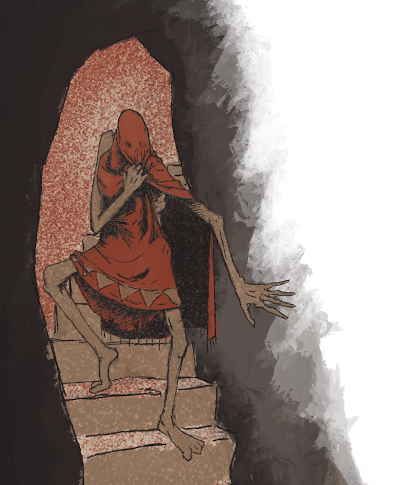
Bestiary II - The Shrouded Carrion

Illustration by yours truly


Amongst the unquiet dead, there are those who cling to the dark and shun light in the vain hope of quelling the sickness from which they suffer. But the disease is a twisted force, and once it has taken hold there is little which can stop it. Shrouded carrion wander endlessly through catacombs, craggy ruins, and moonlit streets, unable to rest in their tombs for the incessant itching hunger which claws at their minds. The unquenchable want which plagues the dead has rooted in their soul.

They bring with them their burial shroud and clutch it tightly around them. As a memento of their former self, it is a shield to ward away the outside world, but it is not enough. The burning light of the living shines through even the thickest of cloth and scorches them all the same, causing pain and madness, turning them inexorably to violence.

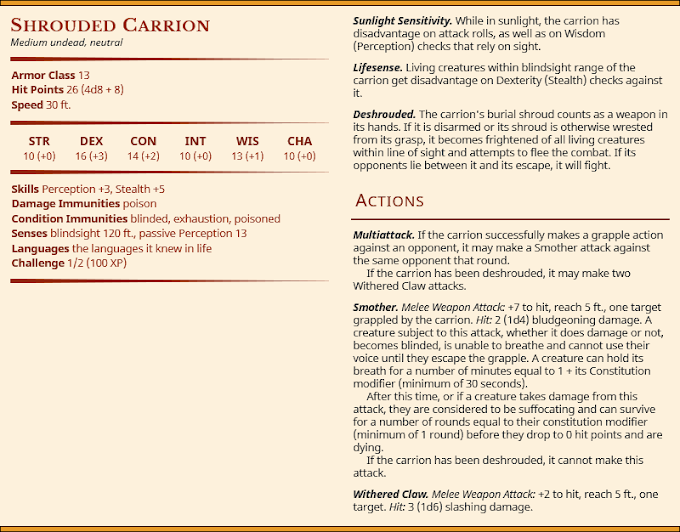
Undead Nature. Carrion do not require air, food, drink, or sleep.

Creeping Assailant. Before combat, a carrion will attempt to hide, gaining an advantageous position to surprise and smother the nearest most vulnerable living creature with their shroud. They swiftly wrap the shroud over their opponent’s head and begin to constrict their face and neck with long, sinewy fingers.

A note about this monster- my initial idea when creating monsters for this project was to make undead a little more interesting. I wanted to make them more varied and potentially quite scary, even at low challenge ratings. There's nothing about the shrouded carrion which suggests they would be difficult to beat in a fight, but their Smother ability makes them a potentially dangerous assailant for the unwary.

 Feel free to use this monster as you wish.

Peace,

O

Bestiary I - The Blubber Golem


An illustration of the Blubber Golem by yours truly.


Apostates and pariahs must still practice their craft, regardless of where they are forced to hide. The town of Leviathan Bay provides such a refuge for those who practice the art of golemancy and study the science of anatomy. Those who tamper with animating dead matter are shunned by polite society (and many amongst impolite society too for that matter), and even at the best of times, human tissue is staggeringly expensive. When resources to create their delicate masterpiece are scarce, artificers must content themselves with more inelegant meat. Fortunately, the squalid town has a literal mountain of it. However, what results is often ugly and ponderous. Constructed with greasy matter gleaned from the corpse of the stranded titan, this strange breed of golem is a crude and clumsy assembly. A rubbery mass of tissue, a lipid monstrosity of oily offal imbued with rudimentary motive force. Its bones are shaved and sawed into shape, bound by slippery cartilage into an ersatz skeleton and grafted with waxy flesh. Its gangly limbs jut out at strange angles, and its joints bend to uncanny degrees. It moves with a clumsy, lurching gait and carries the heavy tools of the flesh gangs- an immense meat cleaver, a serrated greatsword, a huge bonesaw, and the like.

The creature's exact shape varies between specimens, but most have a stunted nub of a head atop a hulking and lumpen body. Its hide is heavy and thick, and slick with foul-smelling oil. This provides the creature with a durable and weatherproof skin, but there is little available to grant the construct much sight or hearing. The golem’s sensory organs are a mere gesture towards function. Many have little more than pinholes for eyes, and an asymmetrical gash of a mouth. They are often dressed in simple garments of rope and hessian cloth, or other materials common amongst seafaring communities- seal skin or shark leather.

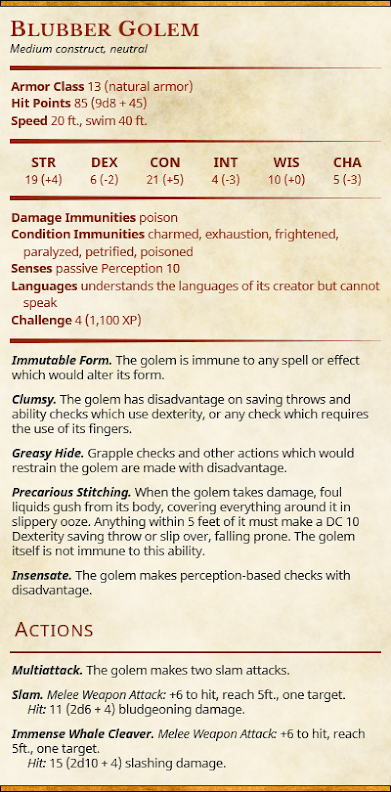
The following rules apply to blubber golems in addition to the general rules for golems found in the Monster Manual:

Graceless Anatomy. The golem’s body is constructed from unsuitable materials and assembled by an artificer with inadequate knowledge of anatomy. It stumbles as it walks, and its limbs flail as it attempts to balance itself.

Mercenary Muscle. Blubber golems are often brought along as crew on whaling ships, or amongst the flesh gangs- land based scavengers who scour the shores for scraps of meat and oil. They carry the heavy loads, and the heavy weapons. Chopping up large whales requires equally large knives. You may replace the golem's Immense Whale Cleaver with another appropriately huge, appropriately sharp weapon.

Pelagic Memories. Blubber golems are made from the stuff of the sea, and their form unconsciously remembers the feel of water. Although they are slow on the land, they can swim perfectly, with a speed of 40 feet per round. Additionally, when they are fully submerged in water, they no longer count as Clumsy.


Feel absolutely free to use this monster in any way you see fit, shove it into your games of nautical nonsense and watery weirdness. I'm going to make a few more posts about monsters I've created and illustrated.


Peace,

O